Anamorphic Cinema Lenses

43 products

Stay in the know

Panel Discussion at Lunar Studios

Everyone Can Take a Picture. Not Everyone Can Hold the Room

What an agent, a Vogue visuals producer and a brand-side creative lead really look for in photographers now. There is a point in almost every creative career where the work alone stops...

View post

Beauty Photography Tips: Three Things I Wish I Knew Earlier

Beauty Photography Tips: Three Things I Wish I Knew Earlier

Beauty photography tips from Oliver Minnett’s Georges workshop, covering lighting, direction, working with a creative team, and using Sony and Profoto gear.

View post

Models on stage at Karla Spetics show

How We Lit Karla Spetic's Australian Fashion Week Show with P...

We were invited by Karla Spetic to help light her runway, we chose Profoto's new LED lights for the job!

View post
Ricardo sits with Ollie and discusses mobile podcasting setups

Sony A7R VI First Thoughts: A Portrait Photographer’s Take on...

Sony has just launched the new Sony A7R VI, the latest camera in its high-resolution Alpha line, and I was lucky enough to spend some time with it earlier this week. I...

View post
Ricardo sits with Ollie and discusses mobile podcasting setups

Mobile Podcasting Setups Explained: From First Rig to Full Pr...

Mobile podcasting isn’t about shortcuts. It’s about picking gear that actually works, in the places podcasts actually happen. I used to chase the “best” setup. Turns out, the best setup is the...

View post
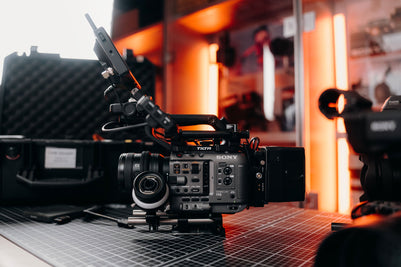
Tilta Sony FX Rigging

Rigging Up Your Sony Cinema Camera

Rigging gets a bad rap because a lot of rigs are built backwards. People buy parts first, bolt everything on, and end up with a camera that looks serious but shoots worse....

View post
Gracaie Stendl Portfolio Images

What Makes a Good Photographer? A Portfolio Deconstruction

Clyde Vaughan Guest post by Clyde Vaughan — ahead of  Clyde's talk on January 22: “How to create incredible images: A talk by Clyde Vaughan”. If you ask “what makes a good...

View post
Ollie Jones holds the 22 kg DJI Power 2000

The End of the Generator? Hands-on with the DJI Power 2000

We’ve all been there: you’re on a remote shoot, beautiful location, but you’re either scrambling to find a power outlet or lugging a massive, noisy petrol generator through the bush. We’ve been...

View post
Oliver Minnett teaching a photography workshop

Why 2026 Might be the year to change from DSLR to Mirrorless

Alright—let’s do the DSLR vs mirrorless thing properly. Not “on paper”, not “in theory”, but head-to-head on the stuff that actually matters when you’re out shooting. My name's Oliver Minnett, I'm Georges...

View post
Two Leica M11P's on a desk

Leica is now at Georges Cameras

Some cameras don’t just document your life; they become part of it. I bought a Leica M6 in 2012. Photography had always been a part of my life; my dad had run...

View post

Frequently asked questions

What is the difference between an anamorphic lens and a spherical lens?

An anamorphic lens compresses the image horizontally during capture, allowing for a widescreen aspect ratio and unique optical characteristics. A spherical lens captures the image without compression and produces a more conventional look.

Do I need special equipment to use Anamorphic Cinema Lenses?

You will need a compatible cinema camera and monitoring setup that supports de-squeeze viewing. Post-production software must also accommodate anamorphic footage processing.

Why do anamorphic lenses create horizontal flares?

The optical design of an anamorphic lens shapes light differently than spherical glass, producing stretched horizontal flares that are a hallmark of cinematic imagery.

Are anamorphic lenses suitable for commercial productions?

Yes. Anamorphic Cinema Lenses are widely used in feature films, music videos and high-end commercials where a distinctive widescreen aesthetic is desired.

Is shooting anamorphic more difficult than shooting spherical?

Anamorphic shooting requires more attention to framing, focus and monitoring, but experienced crews value the creative control and visual character it provides.


Anamorphic Cinema Lenses for Authentic Widescreen Storytelling

True cinematic imagery is not only about resolution, it is about character. Anamorphic Cinema Lenses are chosen by cinematographers who want to create immersive widescreen visuals with distinctive optical personality. From horizontal flares to oval bokeh and enhanced spatial depth, an anamorphic lens delivers the signature aesthetic associated with feature films and high-end commercial productions.

Unlike traditional spherical lenses, anamorphic optics compress the image horizontally during capture. In post-production, the footage is de-squeezed to reveal a wide aspect ratio with expanded field of view and unique rendering characteristics. The result is a frame that feels expansive, dimensional and unmistakably cinematic.

At George’s Cameras, we stock professional Atlas Mercury anamorphic primes designed for modern cinema cameras and serious production environments.

What Defines an Anamorphic Lens?

An anamorphic lens uses specialised optical elements to squeeze the horizontal field of view onto the sensor. Once de-squeezed, the footage reveals:

  1. A true widescreen image without cropping
  2. Horizontal lens flares that stretch across the frame
  3. Oval-shaped out-of-focus highlights
  4. A distinctive sense of depth and separation

Rather than simply widening the frame in post, Anamorphic Cinema Lenses capture more horizontal information at the time of recording. This produces visual nuance and lens character that cannot be replicated with digital effects alone.

Cinematographers often choose anamorphic glass for narrative filmmaking, music videos, commercials and branded content where aesthetic identity matters.

Atlas Mercury Anamorphic Prime Series

The Atlas Mercury series is designed to bring professional anamorphic character into a compact, production-ready form factor. These lenses provide consistent optical performance, smooth focus mechanics and reliable construction suited to demanding workflows.

36mm Anamorphic Prime

The Atlas Lens Co Mercury 36mm Anamorphic Prime offers a wider field of view ideal for environmental scenes, tracking shots and establishing compositions.

This focal length captures space and scale while retaining the signature flares and compression expected from Anamorphic Cinema Lenses.

42mm Anamorphic Prime

The Atlas Lens Co Mercury 42mm Anamorphic Prime provides a balanced perspective suited to dialogue scenes, narrative coverage and commercial storytelling.

Its versatility makes it a core focal length for filmmakers building a cohesive anamorphic set.

72mm Anamorphic Prime

For tighter framing and subject-driven storytelling, the Atlas Lens Co Mercury 72mm Anamorphic Prime delivers compressed perspective and pronounced background separation.

This focal length is particularly effective for dramatic close-ups and controlled cinematic compositions where lens character enhances emotional impact.

Why Choose Anamorphic Cinema Lenses?

Anamorphic lenses are not selected purely for technical reasons, they are chosen for the way they shape light and space. The visual characteristics create a sense of scale that audiences associate with cinema.

Key advantages include expanded horizontal field of view, distinctive flare behaviour, enhanced subject isolation and a cinematic depth that differs from spherical optics.

For filmmakers seeking a recognisable widescreen aesthetic with authentic optical texture, an anamorphic lens provides a practical and creative solution.

Built for Modern Cinema Workflows

The Atlas Mercury range is engineered for compatibility with contemporary cinema cameras and production rigs. With consistent gearing and controlled optical performance across focal lengths, these lenses integrate seamlessly into professional environments.

Shooting anamorphic requires consideration during framing and monitoring, but when executed correctly, it rewards cinematographers with a widescreen look that carries visual authority and narrative presence.

At George’s Cameras, we work with production teams and independent filmmakers to supply Anamorphic Cinema Lenses suited to feature films, branded campaigns and creative projects.

Bring Cinematic Character to Your Production

From expansive landscapes to intimate performances, Anamorphic Cinema Lenses introduce visual depth and widescreen storytelling that define high-end filmmaking.

Explore the Atlas Mercury anamorphic lens range at George’s Cameras and create imagery with unmistakable cinematic identity.