








-v1665700116905.png?500x500&options=w_150)




































Beauty Photography Tips: Three Things I Wish I Knew Earlier
Beauty photography looks simple from the outside.
A clean face, good makeup, sharp focus, a nice lens, and a light pointed in the right direction. Easy.
Except it is not.
Beauty is one of the most technical and unforgiving types of photography you can shoot. Everything matters: skin texture, makeup finish, hair placement, catchlight shape, focal length, lens compression, light direction, shadow density, contrast ratio, colour temperature, exposure, retouching, expression and posture.
After running my recent beauty photography workshop with the support of Sony and Profoto, I kept thinking about the things I wish I understood earlier.
Not just the gear list.
The process.
The things that actually make a beauty image work.


1. It takes a village
The biggest mistake photographers make is thinking beauty photography is something they can do alone.
It rarely works that way.
The makeup artist matters. The hairstylist matters. The model matters. The stylist matters. The assistant matters. The person watching stray hairs, steaming garments, moving flags, checking shine, adjusting jewellery, holding a reflector, or catching the one thing you missed, they all matter.
Your team is the secret ingredient.
In beauty photography, every department shows up in the final image. Makeup has to be built for camera, not just for a mirror. Hair has to hold shape under light and movement. Skin preparation matters. Styling needs to support the face rather than compete with it. The model needs to understand the mood, the expression and the level of precision required.
That means communication is not a soft skill. It is part of the technical process.
If the makeup artist does not know whether you are using hard light, soft light, high contrast, bounce, direct flash or heavy diffusion, the makeup may not photograph the way they expect. If the model does not understand how tight the crop is, they may not realise how much small movements matter. If your assistant does not know what light you are trying to build, they cannot help you refine it quickly.
Good beauty work is built before the shutter is pressed.
You need references. You need a brief. You need to explain the lighting direction, the crop, the mood, the finish, the skin treatment, and what the final images are supposed to do.
The better the team understands the image, the more precise the result becomes.
2. Lighting matters more than the camera
People ask me what camera I use all the time.
For the record, at this workshop I was shooting on the Sony A1 II, with support from Sony Australia. It is an incredible camera for this kind of work: high resolution, excellent autofocus, strong colour, fast handling, and enough file quality to hold up under close beauty crops.
But honestly, the lighting matters more.
A great camera will not save bad light.
Beauty lighting is about shape, control and repeatability. The size of the light source matters. The distance from the subject matters. The angle matters. The surface quality matters. Whether the light is direct, bounced or diffused matters. Whether the modifier is deep, shallow, white, silver, gridded, feathered or used indirectly will change the way skin, bone structure and makeup are rendered.
This is where beauty becomes technical.
A large softbox close to the subject gives you broad, soft light with gentle transitions. A beauty dish gives more shape, snap and contrast while still flattering the face when used well. A large deep umbrella can create beautiful wrap. Bounced light can create a clean base, but without direction it can become too flat. Negative fill can bring shape back into the face. A small shift in height can change the catchlight, shadow under the nose, cheekbone definition and jawline.
It is not enough to make the light soft.
You need to understand what the light is doing.
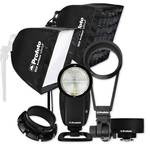
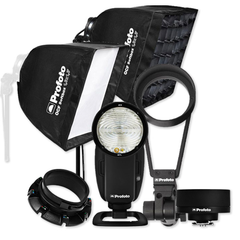
That is one of the reasons I love working with Profoto. Their system gives you a large range of light-shaping tools that are fast to build, consistent in output and easy to adjust under pressure. Softboxes, umbrellas, reflectors, beauty dishes, grids and diffusion all give you different ways to control spread, contrast, falloff and shadow detail.
The rubber grip system on many Profoto modifiers is also genuinely useful. It allows you to rotate and position modifiers quickly, which means you can vary the direction, shape and intensity of the light without slowing the whole shoot down.
That matters on set.
Because lighting is not just about knowing a setup. It is about being able to refine it while people are waiting.
But I'm not about to gatekeep!
My full kit for the day was:
Sony A1 II, 24-70 F2.8 GM2, 100 F2.8 STM OSS GM, 50 F/1.4 GM, Prism tether and Benq SW272U.
3. You need to become a better director
A lot of photographers blame the model when a shoot is not working.
I think that is usually the wrong place to start.
If the person in front of your camera is not delivering what you need, the first question should be: have I communicated clearly enough?
- Do they understand the brief?
- Do they know the crop?
- Do they know how small the movements need to be?
- Do they understand the difference between beauty posing and fashion posing?
- Do they know what I want from the eyes, mouth, hands, shoulders and neck?
- Do they feel comfortable enough to try things without feeling awkward?
This is especially important with beauty, because the frame is unforgiving. When you are shooting tight, a small change can completely shift the image. A few centimetres in chin height can change the jawline. A slight turn can change symmetry. A tense mouth can kill the frame. A hand that is almost right can still feel wrong. A shoulder raised too high can change the whole posture.
Your job is not just to take the photo.
Your job is to guide the person into the frame.
That means your direction needs to be specific, calm and useful. Not vague instructions like “give me more” or “make it stronger.” More what? Stronger how?
Beauty direction needs clarity. Talk about the emotional aspects, get good flow, help your talent understand what you're after. Show references, show the shots you've created so far.
And more importantly give feedback!!
If something is not working, wear the responsibility.
It might not mean the model is bad. It might mean your direction is unclear, your reference is wrong, your lighting is unflattering, your crop is too tight, the makeup needs adjusting, or the set does not feel comfortable enough yet.
Good direction is technical too.
It affects posture, expression, movement, confidence and ultimately the image.
The tools I loved using:
For the workshop, we had the support of Profoto, and having access to a wide range of lighting tools made a huge difference.
I used two Profoto Pro-D3 1250Ws heads as my main lights, primarily as bounced sources to create a soft, even base. The power output gave me plenty of control, especially when working with larger modifiers and bounce setups where you naturally lose light.
Once I had that clean base, I could start shaping the image with smaller, more controlled tools.
That is one of my favourite ways to work with beauty lighting: build an even foundation, then refine the face with direction, fill, contrast and shape.
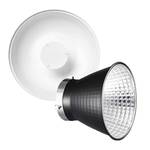
I am also still obsessed with the white Profoto Softlight Reflector. I have had one in my kit for over 10 years, and it is still one of my favourite modifiers. It gives a beautiful balance of softness and structure. It is not as flat as a large softbox, but it is not as aggressive as harder reflectors either. Used subtly, it can give the face shape without making the lighting feel heavy-handed.
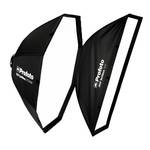
For some of my favourite shots with Sophie, I finished the setup with the Profoto 4x6 RFi Softbox, the largest softbox in the RFi range, a Deep White XL Umbrella for back fill, bounced light, and a very subtle push from the Softlight Reflector.
That gave me control from multiple sides.
The large softbox gave beautiful softness and surface area. The Deep White XL Umbrella helped open the shadows and create a soft back fill. The bounced Pro-D3 heads gave the set an even base. The Softlight Reflector added a controlled, subtle push into the face.
That ability to modify, redirect and balance light from different sides is one of the things I love most about studio lighting.
You are not just lighting the subject.
You are deciding how the face, skin, makeup and shape are being read by the camera.


Beauty photography is not just about beauty
The more I shoot beauty, the more I realise it is not really about making someone look beautiful.
That is part of it, obviously.
But the stronger goal is to make an image feel intentional.
Beauty photography teaches discipline. It teaches you to slow down. It teaches you to look properly. It teaches you how much small decisions matter. It teaches you that a strong image is usually the result of a team working well together, not a photographer trying to do everything alone.
- You need a good team.
- You need controlled light.
- You need clear direction.
- You need to understand how the tools affect the face.
The camera matters, but it is not the whole answer.
A huge thank you to Sony Australia and Profoto for supporting the workshop and helping make the session possible. Having access to reliable camera systems and proper light-shaping tools gives photographers a much clearer way to understand what is actually happening on set.
If you want to learn more about building stronger portfolio work, working with talent, briefing properly and creating images with more intention, just follow this link for my next workshop.
A special thanks to our models pictured above as well: Paige (@paigegoodall_), Xanthe (@xanthetamayo) and Sophie (@sophie.spark), and our incredible makeup artist Katy Nicholls (@katynichollsartistry) for helping bring the session together.
