


-v1665700116905.png?500x500&options=w_150)















How We Lit Karla Spetic's Australian Fashion Week Show with Profoto
Lighting runway is always a compromise.
You are trying to make the designer’s work look beautiful, give the models flattering light, keep the audience experience intact, and make sure the photographers and videographers in the room actually get usable coverage.
That sounds simple until you get into the space.
For Karla Špetić’s show at St Barnabas Church in Ultimo for Australian Fashion Week 2026, the challenge was the layout. The runway was a horseshoe shape inside a church hall, with media positioned around the corners rather than in a traditional pit. The house lights were never designed for a runway, and we had to create a lighting setup that worked for stills, video, guests and the show itself without putting harsh light directly into everyone’s eyes.
I got the call to light the show with Profoto the week before. The brief was clear: make the setup flattering on the talent, consistent for media, and practical within the space.
No small ask.

What we had to work with
For the main runway setup, we had:
- 2 x Profoto L600C
- 2 x Profoto L600D
- 1 x Profoto L1600D
All of the runway lighting was continuous, which made sense for the show. We had stills and video teams working at the same time, so continuous light gave everyone the same visual environment. What the videographers saw is what the photographers saw. What the audience saw is what the models walked through.
Backstage, I used a separate compact flash setup:
- Sony A1
- Sony 24-70mm
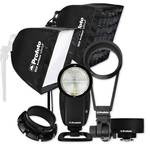
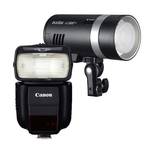
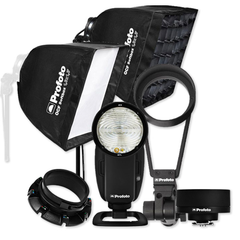
- Profoto A2
- Profoto 60cm Clic Softbox
I’ll get into that later, because that little backstage setup is one of the most useful modern fashion week kits I’ve used.
Colour temperature and the room
We kept the lights fairly consistent, sitting around 5400K.
The room had a lot of wooden panels, which meant the ambient pollution was naturally quite warm. Karla’s collection had a more neutral palette, and we did not want everything shifting too warm, especially once the lights started bouncing around the space.
A slightly cooler daylight balance helped keep the clothing cleaner and the skin more natural.
This is one of those small decisions that matters more than people realise. If you do not account for the room itself, you can light the show beautifully and still end up with files that feel strange.


Power was a real consideration
This is the less glamorous part of lighting that people often forget.
Power matters.
The Profoto L1600D can draw serious power, and the L600C units are not tiny either. In a venue like this, you need to know what circuits you are on and how much load you are asking from the room.
The last thing you want is to trip a circuit mid-show.
Three of the heads were on a separate circuit, so they were less of a concern, but we still had to be mindful of how the setup was distributed. This is always worth thinking through before you get excited about building the prettiest lighting setup in your head.
If the power does not hold, the lighting design does not matter.
The lighting approach
The overall strategy was simple:
Use harder sources with throw where we needed distance, and larger soft sources where we needed flattering coverage close to the models.
That is where Profoto’s modifier range really helped.
The Maxi Zoom and Magnum Reflector gave us reach and shape. The octaboxes and the Deep XL Translucent Umbrella gave us softness, spread and forgiveness.
The trick was not choosing between hard light and soft light. It was using both in the right places.
You can mix hard and soft light really effectively if you understand where the light is travelling, where it falls, and what job each source is doing.
Light 1: L600C with Maxi Zoom Reflector
The first key position was a Profoto L600C with a MaxiZoom Reflector.
This was placed to throw light toward the stage entrance where the models first appeared. We needed reach here because the source could not sit right on top of the runway. The Maxi Zoom gave us the throw we needed without having to flood the entire room.
This light helped carry the models as they entered and moved down the first side of the horseshoe.
The risk with a modifier like the Maxi Zoom is that it can get punchy, especially if it becomes the only thing shaping the face. But because of the distance and how the rest of the setup balanced around it, it gave us useful direction without completely taking over.

Light 2: L600D with 4ft Octa
The most important position in the whole setup was the corner where the models turned toward the main media area.
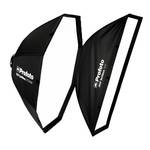
This is where we placed an L600D with a 4ft octabox.
That octa did a huge amount of the heavy lifting. As the models rounded the corner, it gave them soft, flattering light from the front without creating harsh shadows across the face. Because the source was large, it spread beautifully and gave photographers a much more usable moment as the talent changed direction.
This was the “money” position for a lot of the stills coverage.
You could have lit this with a harder source, and it may have looked more dramatic, but it would not have been as forgiving. Runway is not just about making one frame look cool. You need repeated, usable, flattering frames as people move through the space.
That is where the octa made the most sense.

Light 3: L600D with Magnum Reflector
Next to the octa, we placed another L600D with a Magnum Reflector, aimed back toward the stage side.
This light helped balance the face so the models were not only being hit from one side by the Maxi Zoom. Without it, the face could fall into a more uneven half-lit look as the models moved through the turn.
Placement mattered here.
The Magnum was positioned above the octa and above head height, so when the models came closer, it did not fight the soft source or create ugly shadows across the face. By the time talent reached the turn, the octa became the dominant flattering source, while the Magnum gave us the coverage and shape we needed from the opposite direction.
That is the kind of thing that is easy to miss if you are only thinking about brightness.
It is not just “is there enough light?”
It is “what does this light do when the model gets close?”
You can see from the example shots the magnum was above head height so it wasn't shaping the models once they reached the octa.


Light 4: L1600D with Deep XL Translucent Umbrella
The biggest light on the day was the Profoto L1600D.
Initially, I wanted to use a Softlight Reflector to scatter light down the runway. It looked beautiful in testing. It had shape, it had mood, and it looked cool.
But it was not practical.
It was too intense and created too many shadows. This setup had to do more than look interesting from one spot. It had to work for media across the room and keep the talent looking flattering as they moved through the second corner.
After dress rehearsal, it became clear that a more even source would work better. A few photographers and videographers had positioned themselves around that second corner, including some from Getty, and they needed to be able to capture both a full-length shot of the models coming toward them and a secondary wider shot as the models passed.
So we changed the setup.
We moved to a Profoto Deep XL Translucent Umbrella, mounted separately to maximise distance and spread from the L1600D.
That solved the problem.
The umbrella gave us soft, wide illumination spilling out in both directions. It pushed a lot of light into the second corner without creating heavy, dark shadows from an overly intense cross light. It was powerful, diffused, and forgiving.
It was not the modifier that looked coolest in isolation.
It was the modifier that worked best for the job.
That is a big lesson in lighting.
Sometimes the “prettiest” test frame is not the best final decision.


Light 5: L600C with 3ft Octa
The final light was another L600C, placed on the return corner as the models walked back toward the stage.
This had a 3ft octabox attached, giving us soft light as the models exited the runway path.
This was not a “safety light” in the sense of just filling a dark hole. It was more about making sure a third of the stage did not fall away, especially when a third of the guests were seated at that end.
You do not want the light to tell the room that one section of the runway matters less.
Even if the main media moment happens elsewhere, the full show still needs to feel considered.
What changed during rehearsal
We had around two hours in total, but the main setup was built in roughly an hour. Once photographers and videographers arrived for dress rehearsal, we started to see what was working and what was not.
The biggest change was switching the L1600D setup from the Softlight Reflector approach to the Deep XL Translucent Umbrella.
That adjustment came directly from watching how the media were using the space. I initially assumed the second corner would not be as heavily used, but once people found their positions, it was obvious that corner needed a softer, more even approach.
That is why rehearsal matters.
You can draw the floor plan. You can plan the modifiers. You can imagine where everyone will stand.
Then people arrive, and the room tells you what it actually needs.
How it looked in the final images
The final lighting felt soft, flattering and consistent.
That was the goal.
Not overly dramatic. Not obviously “lit” in a distracting way. Not blasting the talent or destroying the atmosphere of the room.
It gave photographers and videographers enough illumination to work, while still keeping the show feeling elegant and considered.
Karla’s work has a quiet strength to it. Her designs often balance softness and precision, femininity and structure. The lighting needed to support that, not fight it.
A neutral palette, a church hall, a horseshoe runway and mixed media needs could have turned into a nightmare, but the final result felt clean and controlled.


Backstage: my compact Profoto A2 setup
I've done backstage and event reportage for a long time.
I used to be the Fashion Week Editor for IMG for five years, so I have spent a lot of time dealing with badly lit setups, difficult backstage rooms, tight corners, frantic teams and gear setups that are far too annoying for the job.
Back then, we used some very janky handheld softbox setups.
They worked, but they were not elegant.
For this show, I used a much better version of that idea:
This is a brilliant backstage setup.
The A2 is compact, the 60cm Clic Softbox is lightweight, and the whole thing gives you flattering, controlled light without needing a stand. Because the softbox clicks up and down quickly, I could collapse it when I was not using it and throw it into a shoulder bag.
That matters backstage.
Fashion Week is not the place to carry gear for the sake of it. The hardest part has always been bringing enough to do the job properly without bringing so much that you become slow, annoying or in everyone’s way.
For backstage work, I would recommend this kind of setup to almost anyone. It is portable, flattering and quick enough to actually use in the chaos.


What I would change next time
I would always love more heads.
That is probably the most honest answer.
The setup worked well, but if I had access to another L1600D, I would have liked to mirror both sides more closely from a visual standpoint. Not because the show failed without it, but because symmetry gives you more control and more polish when the runway itself is irregular.
More lights do not automatically mean better lighting.
But in a space like this, with an awkward runway shape and media spread across multiple corners, more fixtures give you more options. More control. More ability to balance the room without forcing one light to solve three problems at once.
What photographers can learn from this setup
The big lesson is that runway lighting is not about one perfect light.
It is about coverage, control and compromise.
You can mix hard and soft sources if each one has a clear job. You can use throw to your advantage. You can use large soft sources to make difficult corners more flattering. You can light for stills and video at the same time if you think about consistency rather than just exposure.
And most importantly, you need to light the path, not just the hero position.
Fashion Week is hard. You are often fighting flickering house lights, bad overheads, improvised media positions, tight spaces and limited setup time. A good lighting setup gives people options. It means photographers are not completely punished because they are half a metre to the left. It means videographers get usable movement. It means the designer’s work is seen properly.
That is the job.
Why Profoto worked here
Profoto made this setup easier because the system gave us flexibility.
The power was there when we needed throw. The modifiers gave us different shapes and levels of softness. The L-series continuous lights let both photographers and videographers work under the same light. The A2 gave me a compact backstage setup that was quick, flattering and easy to carry.
That combination matters.
Lighting is not just about output. It is about having the right tool for the right part of the job.
A Maxi Zoom and a Deep XL Umbrella do very different things. A Magnum and a 4ft octa do very different things. That difference is the point.
When you understand what each modifier does, you stop guessing and start building the light around the problem in front of you.
Final thoughts
This was a tricky room, but a good one.
The horseshoe runway forced us to think carefully about coverage. The church hall made power and ambient spill part of the equation. The media positions meant the light had to work from more than one angle. And the collection needed to feel soft, controlled and flattering without turning the show into a lighting demo.
That is what I like about this kind of job.
It is practical. It is imperfect. It forces decisions.
And ultimately, that is what good lighting is: making the best possible set of decisions for the space, the subject, the client and the people who need to create work inside it.
If you are interested in learning more about portrait, studio or lighting setups, I teach regular lighting workshops through Georges Cameras.
You can see our upcoming workshops here!
And find me on Instagaram here!
Cheers,
Oliver