


-v1665700116905.png?500x500&options=w_150)






















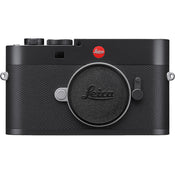
Leica M EV1 Mirrorless Camera
Leica M EV1 Mirrorless Camera
The First M with a Built-In EVF
A new milestone for Leica, the M EV1 is the first M-system camera to feature an integrated electronic viewfinder rather than a traditional optical rangefinder. This simple-but-significant difference makes the EV1 particularly well-suited to working with ultra-wide and long focal lengths, as well as faster lenses, while still maintaining the classic slim body design, same M lens mount, and proven imaging capabilities from the M11-series of rangefinder cameras.
Unique Viewing and Focusing Experience
5.76m-Dot OLED Electronic Viewfinder
Taking the place of the optical viewfinder, the M EV1 features the first-ever integrated electronic viewfinder in an M-system camera body.
The OLED panel has a sharp 5.76m-dot resolution and the viewfinder has a large 0.76x magnification, integrated diopter adjustment, and covers 100% of the image frame.
The EVF displays exactly what the sensor is recording, allowing for critical framing and more reliable focusing, especially with faster Summilux and Noctilux lenses and when working at shallow depths of field.
Another key benefit of the EVF is the ability to work with focal lengths not typically supported by the M rangefinder cameras' viewfinders, including ultra-wide and telephoto lenses.
The typical restrictions of the rangefinder focusing system are also no longer applicable, enabling the accurate use of macro lenses, adapted lenses, and lenses with shorter minimum focusing distances.
The Digital Zoom function can now be previewed in the viewfinder with 1.3x or 1.8x frame crops visible within the area of the full image frame.
Focus Assistants and FN Button
The EVF also facilitates working with different focusing tools to help in acquiring sharp focus with various lenses:
Focus Peaking highlights sharp, in-focus areas and edges in bright colours to make it easier to recognise when a subject is in focus.
Focus Aid/Magnification offers two magnification steps to zoom into the frame and better recognise when details are in focus. This setting can be manually activated via the FN button or set to automatically activate when turning the focus ring of the lens.
With the optical viewfinder being replaced by an EVF, the former frame selector lever now has a new purpose as an FN button for toggling the focusing aids or digital zoom; a long push on the lever is used to assign a function and short pushes toggle the chosen function on or off.
Real-time exposure preview allows seeing the effects of exposure and depth of field changes prior to making an exposure.
Shooting data and exposure information is visible from within the EVF; this information is still relegated to the bottom of the frame, leaving an unencumbered and full-frame image for better composition and focusing accuracy.
Composition aids, including a grid and a horizon level, can also be seen within the viewfinder.
Advanced Imaging Technology
60MP Full-Frame BSI CMOS Sensor
Featuring the high-resolution imaging capabilities of the M11 series, the M EV1 sports the same 60MP full-frame CMOS sensor with a back-illuminated (BSI) design that offers impressive noise performance and fast readout speeds.
The higher resolution suits more detail-oriented applications, like landscape and architectural subjects, and the noise-reduction benefits of the BSI design improve clarity and colour accuracy when working in low-light conditions with higher ISOs.
The sensor's physical design also includes an updated ultra-thin dual-layer filter glass, which absorbs UV and IR wavelengths for greater clarity and more accurate rendering from the M lenses.
Triple Resolution Technology
This unique pixel binning process allows photographers to select 60MP, 36MP, or 18MP output, with each resolution making use of the full sensor area and providing rich 14-bit colour. By pixel binning, rather than cropping, the lower resolutions have improved dynamic range and noise levels:
60MP: 14 stops of dynamic range, highest resolution
36MP: 15 stops of dynamic range, best balance of resolution and noise
18MP: 15 stops of dynamic range, lowest noise levels
Maestro III Image Processor
The Maestro III processor contributes to the faster processing and Triple Resolution Technology, as well as helps achieve a wider sensitivity range than in previous generation M cameras. An ISO 64-50000 range is now available for greater detail, quality, and natural colour rendering at lower ISO settings. The Maestro III also enables continuous shooting at up to 4.5 fps and facilitates fast file saving for an intuitive shooting experience.
Additional Imaging Features
An electronic shutter function permits shooting at shutter speeds up to 1/16,000 sec, which is useful for working with faster f/0.95 lenses without the need for ND filters. A mechanical shutter still offers shutter speed support up to 1/4000 sec and flash sync at 1/180 sec.
Multi-field exposure metreing is available in addition to spot and centre-weighted average, which helps reduce the need to metre and then re-compose before shooting.
Two digital zoom steps can simulate working with longer focal length lenses by cropping into the image slightly, at 1.3x (39MP) and 1.8x (18MP) levels. These are reversible crops when recording a DNG or permanent crops if shooting straight to JPG.
Long Exposure Noise Reduction helps to reduce the appearance of noise but can also be disabled for faster saving times.
Leica Content Credentials with Content Authenticity Initiative Technology
The Content Authenticity Initiative (CAI) is a collabourative effort initiated by Adobe in partnership with various other organisations, including The New York Times and Leica. Its primary goal is to develop a standard for digital content attribution.
In the M EV1, this technology shows up as Leica Content Credentials. By using a secure processing chip, the camera will encrypt image metadata at the point of capture. This information can then be independently verified and even appended to when using compatible applications, such as Adobe Photoshop. Viewers can then verify the provenance of the image and confirm the veracity of the image. The aim is to give viewers more confidence in the images they are looking at and provide creators with another way to maintain credits.
Clean, Revised M Camera Design
Rear LCD and Body Details
Rear 2.95" 2.3m-dot touchscreen LCD features an updated design that is brighter for improved visibility in sunny conditions.
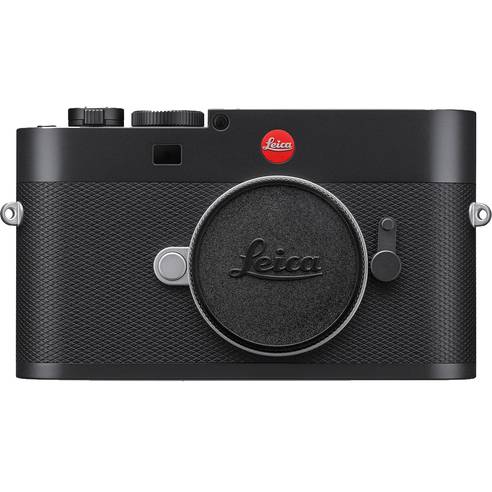
Without the optical viewfinder, the M EV1 features a clean, streamlined design on the front of the camera and the body also has a new diamond pattern leatherette.
Revised menu layout matches the Q and SL systems for more intuitive navigation and faster settings changes right from the first menu page.
Live view stabilisation helps reduce the appearance of camera shake; this electronic stabilisation makes it easier to manually focus longer focal length lenses with greater accuracy.
By replacing the optical viewfinder with an electronic viewfinder, the M EV1 sheds some weight compared to the rangefinder camera-it weighs 0.49 kg, which is 0.45 kg lighter than the M11-P.
Like the M11, Q, and SL-series cameras, this camera does not have a removable baseplate; instead, the M EV1 uses the BP-SCL7 battery that is inserted directly into the base of the camera body.
BP-SCL7 lithium-ion battery is CIPA-rated for 237 shots per charge when working predominantly with the EVF, or 244 shots per charge if primarily using the LCD.
Design also incorporates a single UHS-II SD memory card slot within the battery compartment.
Built-in 64GB memory means you can forgo using a memory card altogether, or use the internal memory in conjunction with an SD card to simulate having dual card slots for splitting file types or for overflow storage. Image files can also be transferred from the internal memory to the SD card for easy backup.
USB-C port on the base permits in-camera battery charging and file transferring.
Wired and Wireless Connectivity
The USB-C port can be used in conjunction with the included FOTOS Cable, which allows direct attachment to an Apple iPhone via the Leica FOTOS app for easy file management and sharing.
Wi-Fi and Bluetooth can also be used for wireless connecting the camera to an iOS device using the FOTOS app.
In-app geotagging is possible along with the ability to select favorites and apply ratings to images via your mobile device.
Key Features:
First M Camera with Integrated EVF
60MP Full-Frame BSI CMOS Sensor
Leica Content Credentials Technology
FN Button and Focus Assist
5.76m-Dot 0.76x Magnification OLED Viewfinder
3" Touchscreen with Gorilla Glass
64GB Internal Memory and SD UHS-II Slot
ISO 64-50000 Shooting Range
Up to 4.5 fps Shooting
Wi-Fi and USB-C Connectivity
Dedicated FOTOS Mobile App
Lightweight Aluminium Top Plate
What's in the Box:
Leica M EV1 Mirrorless Camera
Leica BP-SCL7 Lithium-Ion Battery
Leica Body Cap for Leica M Cameras
USB-C Cable
Carrying Strap
Accessory Shoe Cover
Price Match
Fill out the price match form below, and we will be in touch shortly.
Price Match
Fill out the price match form below, and we will be in touch shortly.
 If you'd like to know when it's due, we're here to help!
 Call us during business hours at
  Chat live with our team on-site.
 Or email us anytime at info@georges.com.au with the subject "Awaiting Arrival"
Checking availability...
Product Overview
Leica M EV1 Mirrorless Camera
The First M with a Built-In EVF
A new milestone for Leica, the M EV1 is the first M-system camera to feature an integrated electronic viewfinder rather than a traditional optical rangefinder. This simple-but-significant difference makes the EV1 particularly well-suited to working with ultra-wide and long focal lengths, as well as faster lenses, while still maintaining the classic slim body design, same M lens mount, and proven imaging capabilities from the M11-series of rangefinder cameras.

Need advice?
Speak to one of our dedicated Australian-based sales team members.
Key Features
60 Megapixels
Leica M EV1 Mirrorless Camera capture stunning high resolution images with the 60MP BSI CMOS sensor.
ISO 125-200000
Leica M EV1 Mirrorless Camera designed to shoot in varying light conditions, the camera has a native ISO 125-200000 range.
Lithium Ion Battery
Leica M EV1 Mirrorless Camera uses lithium ion batteries for convenient power.
2.95" LCD Touchscreen
Leica M EV1 Mirrorless Camera features a bright 2.95-inch high-resolution touchscreen, delivering clear image review.
Electronic Viewfinder
Leica M EV1 Mirrorless Camera is equipped with a high resolutions 5.76m-Dot/0.76x magnification electronic viewfinder.
Modern Rangefinder Innovation
Leica M EV1 Mirrorless Camera

Precision in Motion
Delivers fast, accurate autofocus and responsive mirrorless performance, combining Leica’s renowned craftsmanship with seamless handling for every photographic moment.

Iconic Leica Redefined
Combines Leica’s legendary rangefinder heritage with modern mirrorless technology, delivering exceptional image quality, intuitive controls, and cutting-edge performance.
Price Match
Fill out the price match form below, and we will be in touch shortly.
Price Match
Fill out the price match form below, and we will be in touch shortly.
Product Reviews
Blog posts

Beauty Lighting: How to Combine Hard and Soft Light to Make S...
A working beauty photographer’s guide to combining hard and soft light, beauty dish vs softbox, grids, negative fill and a clamshell setup you can copy, for skin that pops.
View post
Everyone Can Take a Picture. Not Everyone Can Hold the Room
What an agent, a Vogue visuals producer and a brand-side creative lead really look for in photographers now. There is a point in almost every creative career where the work alone stops...
View post
Beyond Reach: My Experience With the Fujifilm XF400mmF4.5 Sup...
Explore our hands-on experience with the Fujifilm XF400mmF4.5, covering its sharpness, autofocus, reach and performance for sport, wildlife, landscapes and portraits.
View post
Learn to Get the Shot Right In-Camera
Beauty photography tips from Oliver Minnett’s Georges workshop, covering lighting, direction, working with a creative team, and using Sony and Profoto gear.
View post
Stop Trying to Learn Everything at Once
Beauty photography tips from Oliver Minnett’s Georges workshop, covering lighting, direction, working with a creative team, and using Sony and Profoto gear.
View post
Beauty Photography Tips: Three Things I Wish I Knew Earlier
Beauty photography tips from Oliver Minnett’s Georges workshop, covering lighting, direction, working with a creative team, and using Sony and Profoto gear.
View post
How We Lit Karla Spetic's Australian Fashion Week Show with P...
We were invited by Karla Spetic to help light her runway, we chose Profoto's new LED lights for the job!
View post
Sony A7R VI First Thoughts: A Portrait Photographer’s Take on...
Sony has just launched the new Sony A7R VI, the latest camera in its high-resolution Alpha line, and I was lucky enough to spend some time with it earlier this week. I...
View post
Mobile Podcasting Setups Explained: From First Rig to Full Pr...
Mobile podcasting isn’t about shortcuts. It’s about picking gear that actually works, in the places podcasts actually happen. I used to chase the “best” setup. Turns out, the best setup is the...
View post
Rigging Up Your Sony Cinema Camera
Rigging gets a bad rap because a lot of rigs are built backwards. People buy parts first, bolt everything on, and end up with a camera that looks serious but shoots worse....
View post