


-v1665700116905.png?500x500&options=w_150)


















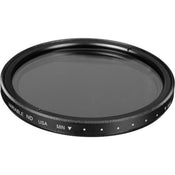
Tiffen Variable ND Filter (52mm, 2 to 8-Stop)
Tiffen Variable ND Filter (52mm, 2 to 8-Stop)
This 52mm Variable ND Filter from Tiffen offers a unique way of maintaining control over your depth of field and presents an efficient way to create special effects. Designed with a built-in rotating ring that controls neutral density ranging from 2 to 8 stops (0.6-2.4), it allows heavier density for a slower shutter speed. The longer exposure allows the shutter to remain open long enough to record the same amount of light, but will also create movement within the shot. It eliminates having to buy and carry around individual neutral density filters. With this one filter, you can rotate to the degree of ND you want, saving money and time.
Simply mount the filter on your lens, set it to "Min" density, then frame and focus. Care must be taken when focusing at heavier densities to make sure focus is accurate. If it isn't, you can switch to manual focus and rotate to the desired degree of filtration.
For example, if your standard exposure without the filter is 1/500 at f/8 and you then set the filter to "Min", you change the shutter speed to 1/125 at the same aperture - thereby losing 2 stops of speed while gaining a hint of blur in the image. If that's not enough filtration, continue rotating the filter until you reach the shutter speed you desire. Using the above example, you can get down to 1/2 second at f/8 (8 stops). It should be noted that the calibration marks on the filter ring are to be used only for reference and should not be regarded as accurate settings for specific densities.
Neutral Density filters are used to create unusual special effects including capturing the blur of rippling water in a waterfall or the swirling effect of city traffic. Since it allows the use of slower shutter speeds in bright light, it becomes possible to create special effects that would normally not be possible without the filter. Since it can also help control your depth of field, it permits you to shoot at wider apertures. Ultimately, its value is in helping to prevent bright, overly washed-out images shot in bright light.
The Colour Core process allows Tiffen to control the colour and density of their filters, and the characteristics of special effects filters with greater accuracy than typical dyed-in-the-mass filters, which usually exhibit colour and density variations. In this way, Tiffen can better control the various densities of their filters and thereby create more exact degrees of filtration.
Thin 9mm Profile Ring
Wide front filter ring helps reduce the possibility of vignetting (the darkening of corners) at wide angles and is not deep enough to accommodate a lens cap.
Allows continuous control over the amount of light coming through your lens in an approximate range of 2 (ND 0.6) to 8 (ND 2.4) stops.
This filter features a 62mm front thread for mounting additional filters or other accessories. Due to the slim nature of the design, not all accessories will fully thread onto the filter. Also, the use of additional filters and accessories may result in vignetting.
4 Main Uses of Neutral Density Filters
Enable use of slow shutter speeds, especially with high-speed ISOs, to record movement in waterfalls, clouds, or cars.
Decrease depth of field by allowing wider apertures to be used, which helps separate subjects from their background.
Decrease the effective ISO of high-speed film (above ISO 400) and allow it to be used outdoors in bright situations.
Allow cine and video cameras (which have fixed shutter speeds) to film snow, sand, or other bright scenes which could cause overexposure.
Colour Core Technology
Allows control over the colour and density of filters, and the characteristics of special effects filters with greater accuracy than typical dyed-in-the-mass filters, which usually exhibit colour and density variations.
Offers better control over various densities of filters and creates more exact degrees of filtration.
Key Features:
Variable 0.6 to 2.4 Optical Density
Colour Core Glass
Black Aluminium Filter Ring
Rotating Ring to Choose Degree of ND
Eliminates Buying Many ND Filters
Use to Create Blur & Special Effects
Use with Film or Digital
Wide Outer Ring Reduces Vignetting
What's in the Box:
Tiffen Variable ND Filter (52mm, 2 to 8-Stop)
Carry Pouch
Price Match
Fill out the price match form below, and we will be in touch shortly.
Price Match
Fill out the price match form below, and we will be in touch shortly.
 If you'd like to know when it's due, we're here to help!
 Call us during business hours at 02 9299 0177.
 Chat live with our team on-site.
 Or email us anytime at info@georges.com.au with the subject "Awaiting Arrival"
Checking availability...
Product Overview
Tiffen Variable ND Filter (52mm, 2 to 8-Stop)
This 52mm Variable ND Filter from Tiffen offers a unique way of maintaining control over your depth of field and presents an efficient way to create special effects. Designed with a built-in rotating ring that controls neutral density ranging from 2 to 8 stops (0.6-2.4), it allows heavier density for a slower shutter speed. The longer exposure allows the shutter to remain open long enough to record the same amount of light, but will also create movement within the shot. It eliminates having to buy and carry around individual neutral density filters. With this one filter, you can rotate to the degree of ND you want, saving money and time.

Need advice?
Speak to one of our dedicated Australian-based sales team members.
Price Match
Fill out the price match form below, and we will be in touch shortly.
Price Match
Fill out the price match form below, and we will be in touch shortly.
Product Reviews
Blog posts

Beauty Lighting: How to Combine Hard and Soft Light to Make S...
A working beauty photographer’s guide to combining hard and soft light, beauty dish vs softbox, grids, negative fill and a clamshell setup you can copy, for skin that pops.
View post
Everyone Can Take a Picture. Not Everyone Can Hold the Room
What an agent, a Vogue visuals producer and a brand-side creative lead really look for in photographers now. There is a point in almost every creative career where the work alone stops...
View post
Beyond Reach: My Experience With the Fujifilm XF400mmF4.5 Sup...
Explore our hands-on experience with the Fujifilm XF400mmF4.5, covering its sharpness, autofocus, reach and performance for sport, wildlife, landscapes and portraits.
View post
Learn to Get the Shot Right In-Camera
Beauty photography tips from Oliver Minnett’s Georges workshop, covering lighting, direction, working with a creative team, and using Sony and Profoto gear.
View post
Stop Trying to Learn Everything at Once
Beauty photography tips from Oliver Minnett’s Georges workshop, covering lighting, direction, working with a creative team, and using Sony and Profoto gear.
View post
Beauty Photography Tips: Three Things I Wish I Knew Earlier
Beauty photography tips from Oliver Minnett’s Georges workshop, covering lighting, direction, working with a creative team, and using Sony and Profoto gear.
View post
How We Lit Karla Spetic's Australian Fashion Week Show with P...
We were invited by Karla Spetic to help light her runway, we chose Profoto's new LED lights for the job!
View post
Sony A7R VI First Thoughts: A Portrait Photographer’s Take on...
Sony has just launched the new Sony A7R VI, the latest camera in its high-resolution Alpha line, and I was lucky enough to spend some time with it earlier this week. I...
View post
Mobile Podcasting Setups Explained: From First Rig to Full Pr...
Mobile podcasting isn’t about shortcuts. It’s about picking gear that actually works, in the places podcasts actually happen. I used to chase the “best” setup. Turns out, the best setup is the...
View post
Rigging Up Your Sony Cinema Camera
Rigging gets a bad rap because a lot of rigs are built backwards. People buy parts first, bolt everything on, and end up with a camera that looks serious but shoots worse....
View post


