


-v1665700116905.png?500x500&options=w_150)

















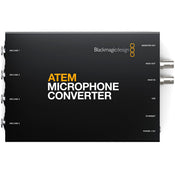
Whether you're building a podcasting studio or you just need more microphones, the Blackmagic ATEM Microphone Converter allows audio-input expansion for your ATEM Television Studio by converting four analog XLR inputs to MADI. Equipped with two BNC MADI I/O ports, the Microphone Converter simply plugs into the ATEM Television Studio MADI port, so there's no complex setup required—and additional units can even be daisy chained for more sources. The four XLR-1/4" combo analog inputs are mic-/line-selectable and provide 48V phantom power. The ATEM Microphone Converter utilizes 32-bit float digital preamps and eight ADCs per input to capture clip-free, 24-bit / 48 kHz recordings with an extremely low noise floor, a wide dynamic range, and very low distortion—no matter how loud or quiet a performance gets. A convenient HDMI output with scrolling audio waveforms enables you to connect a display to monitor the status of your audio. USB and Ethernet ports allow for remote admin and software updates via the ATEM Software Control app.

Blackmagic ATEM Microphone Converter
Whether you're building a podcasting studio or you just need more microphones, the Blackmagic ATEM Microphone Converter allows audio-input expansion for your ATEM Television Studio by converting four analog XLR inputs to MADI. Equipped with two BNC MADI I/O ports, the Microphone Converter simply plugs into the ATEM Television Studio MADI port, so there's no complex setup required—and additional units can even be daisy chained for more sources. The four XLR-1/4" combo analog inputs are mic-/line-selectable and provide 48V phantom power. The ATEM Microphone Converter utilizes 32-bit float digital preamps and eight ADCs per input to capture clip-free, 24-bit / 48 kHz recordings with an extremely low noise floor, a wide dynamic range, and very low distortion—no matter how loud or quiet a performance gets. A convenient HDMI output with scrolling audio waveforms enables you to connect a display to monitor the status of your audio. USB and Ethernet ports allow for remote admin and software updates via the ATEM Software Control app.
Digital Preamplifier Design
With the four, wide-dynamic-range inputs that eliminate the need for analog preamplifiers, microphone levels are adjusted by a digital preamplifier gain stage that is extremely stable.
The analog audio levels of different microphone types and brands can vary widely, so this digital gain stage allows compensation for the specific brand of microphone you use. Best of all, the digital preamplifier is processed in the full internal 32-bit float RAW audio bit depth, so you're adjusting with much greater precision than the MADI audio standard can support. This results in an extremely clean and noise-free gain stage. Then, the final levels can be finessed on the ATEM audio mixer as you work.
High-End Analog-to-Digital Conversion
The ATEM Microphone Converter steps outside conventional audio industry design practice of using an individual audio ADC, as each input implements analog-to-digital conversion using eight high-dynamic-range audio ADCs that function collectively as one ultrahigh-dynamic-range audio ADC. This means each input channel delivers an impressive 131 dBA of dynamic range. Plus you get a remarkably low distortion of only 0.002%.
Extremely Low -129 dBV Noise Floor
A common problem with mic converters is the higher noise floor where electrical noise is generated in the preamplifiers. The ATEM Microphone Converter eliminates this problem by using a very different design. The input is converted directly using its ultrahigh-dynamic-range conversion, so you pass RAW audio to the switcher, and then let the switcher apply as much gain as required for the correct audio level.
This means you don't get an injection of noise caused by an analog gain stage, so you get an extremely low, fixed noise floor of -129 dBV, regardless of digital gain applied.
Precisely Matched Analog Inputs
The ATEM Microphone Converter features extremely precise matching between the four audio-input channels. The multi-ADC-per-input design technique means that each analog audio input has very similar specifications and tolerances, so all input channels are statistically more uniform. This means you get similar performance no matter what input you connect the microphone to—and even between multiple ATEM Microphone Converters.
Connects via MADI for Multichannel Audio
The ATEM Microphone Converter’s MADI output embeds the four analog inputs as MADI channels 1, 2, 3, and 4. The converter also includes a MADI input, which is used to loop multiple converters when you need more than four channels of audio on a single MADI link.
This means if a second converter is connected to the input of another, the upstream converter will stack its four channels above the four channels on the downstream converter.
HDMI Monitoring with Scrolling Audio Waveforms
The ATEM Microphone Converter also includes an HDMI video monitoring output, so you can connect a simple TV or computer monitor for a full status display. It enables you to display four scrolling waveforms over the last 60 seconds of recording time, which is informative to watch. There are also audio meters to show the levels at the input connectors. Each channel also includes a custom label set via the software utility.
There are also indicators to show the switch settings for mic-/line-input selection and phantom power. Plus if you daisy-chain converters, the monitoring output will adapt and display more than four channels. You can even set a converter name that will be displayed on the monitoring.
Key Features
-
Audio Inputs for ATEM Television Studio
-
Connects to Switcher via MADI
-
4 XLR-1/4" Combo Mic/Line Inputs, +48V
-
32-Bit Float Digital Preamps
-
8 ADCs/Channel, 24-Bit / 48 kHz Audio
-
Easy-to-Use, No Setup Required
-
64-Channel MADI Digital Audio I/O Ports
-
HDMI Monitor Out
-
USB-C and Ethernet Ports
-
Works with ATEM Software Control App
Price Match
Fill out the price match form below, and we will be in touch shortly.
Price Match
Fill out the price match form below, and we will be in touch shortly.
 If you'd like to know when it's due, we're here to help!
 Call us during business hours at 02 9299 0177.
 Chat live with our team on-site.
 Or email us anytime at info@georges.com.au with the subject "Awaiting Arrival"
Checking availability...
Product Overview
Whether you're building a podcasting studio or you just need more microphones, the Blackmagic ATEM Microphone Converter allows audio-input expansion for your ATEM Television Studio by converting four analog XLR inputs to MADI. Equipped with two BNC MADI I/O ports, the Microphone Converter simply plugs into the ATEM Television Studio MADI port, so there's no complex setup required—and additional units can even be daisy chained for more sources. The four XLR-1/4" combo analog inputs are mic-/line-selectable and provide 48V phantom power. The ATEM Microphone Converter utilizes 32-bit float digital preamps and eight ADCs per input to capture clip-free, 24-bit / 48 kHz recordings with an extremely low noise floor, a wide dynamic range, and very low distortion—no matter how loud or quiet a performance gets. A convenient HDMI output with scrolling audio waveforms enables you to connect a display to monitor the status of your audio. USB and Ethernet ports allow for remote admin and software updates via the ATEM Software Control app.

Need advice?
Speak to one of our dedicated Australian-based sales team members.
Price Match
Fill out the price match form below, and we will be in touch shortly.
Price Match
Fill out the price match form below, and we will be in touch shortly.
Product Reviews
Blog posts

Beauty Lighting: How to Combine Hard and Soft Light to Make S...
A working beauty photographer’s guide to combining hard and soft light, beauty dish vs softbox, grids, negative fill and a clamshell setup you can copy, for skin that pops.
View post
Everyone Can Take a Picture. Not Everyone Can Hold the Room
What an agent, a Vogue visuals producer and a brand-side creative lead really look for in photographers now. There is a point in almost every creative career where the work alone stops...
View post
Beyond Reach: My Experience With the Fujifilm XF400mmF4.5 Sup...
Explore our hands-on experience with the Fujifilm XF400mmF4.5, covering its sharpness, autofocus, reach and performance for sport, wildlife, landscapes and portraits.
View post
Learn to Get the Shot Right In-Camera
Beauty photography tips from Oliver Minnett’s Georges workshop, covering lighting, direction, working with a creative team, and using Sony and Profoto gear.
View post
Stop Trying to Learn Everything at Once
Beauty photography tips from Oliver Minnett’s Georges workshop, covering lighting, direction, working with a creative team, and using Sony and Profoto gear.
View post
Beauty Photography Tips: Three Things I Wish I Knew Earlier
Beauty photography tips from Oliver Minnett’s Georges workshop, covering lighting, direction, working with a creative team, and using Sony and Profoto gear.
View post
How We Lit Karla Spetic's Australian Fashion Week Show with P...
We were invited by Karla Spetic to help light her runway, we chose Profoto's new LED lights for the job!
View post
Sony A7R VI First Thoughts: A Portrait Photographer’s Take on...
Sony has just launched the new Sony A7R VI, the latest camera in its high-resolution Alpha line, and I was lucky enough to spend some time with it earlier this week. I...
View post
Mobile Podcasting Setups Explained: From First Rig to Full Pr...
Mobile podcasting isn’t about shortcuts. It’s about picking gear that actually works, in the places podcasts actually happen. I used to chase the “best” setup. Turns out, the best setup is the...
View post
Rigging Up Your Sony Cinema Camera
Rigging gets a bad rap because a lot of rigs are built backwards. People buy parts first, bolt everything on, and end up with a camera that looks serious but shoots worse....
View post


- Choosing a selection results in a full page refresh.
- Opens in a new window.